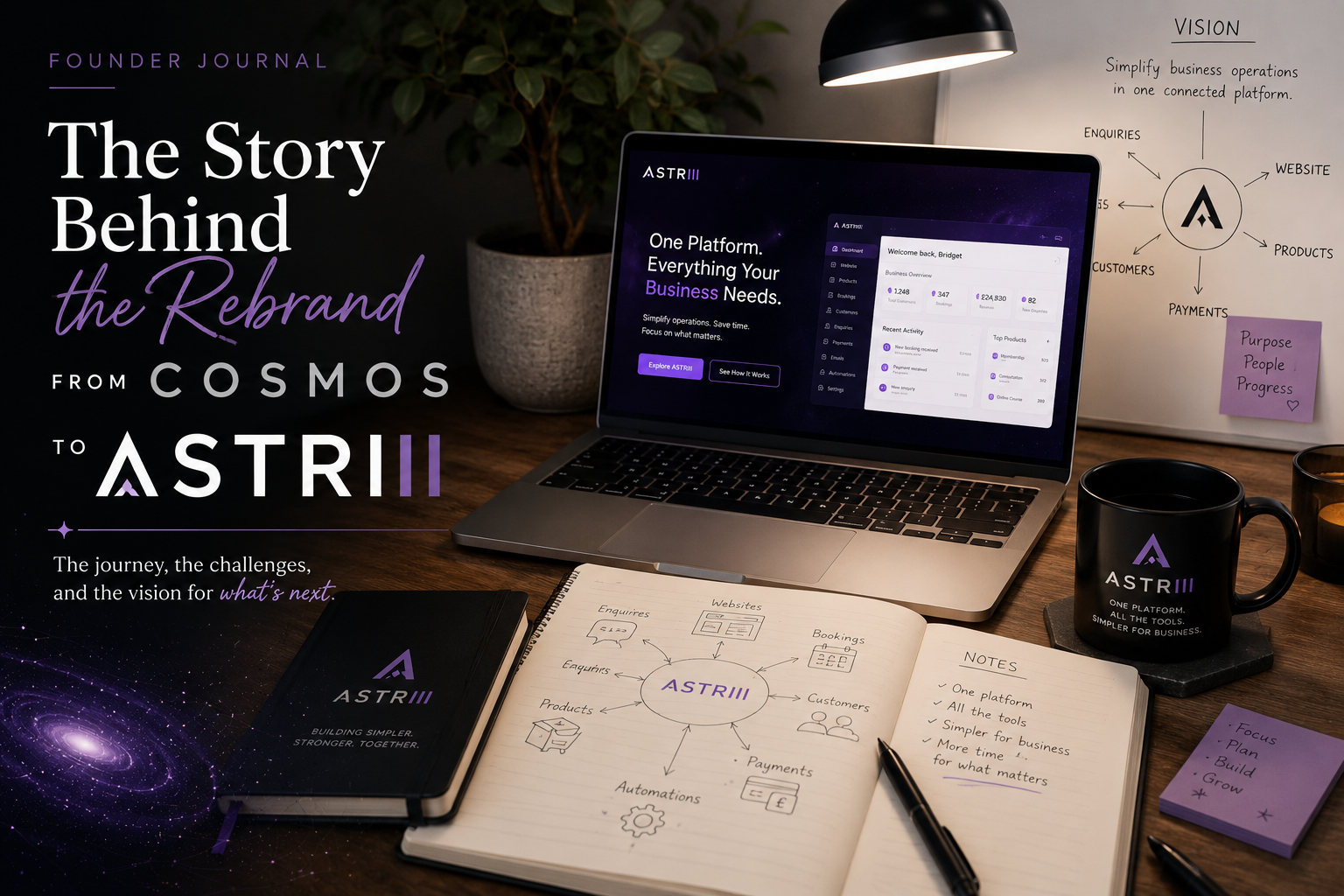
The Story Behind the Rebrand from Cosmos to ASTRIII
Founder Journal • By Bridget Sarah
If you had told me ten years ago that I would be building a business platform, I probably would have laughed.
Back then, I was simply doing what I loved. I enjoyed building websites, learning new technologies, solving problems, and helping businesses establish an online presence. Like many developers, my journey started with WordPress. Over the years, that grew into building online stores, membership platforms, mobile applications, custom integrations, hosting solutions, and supporting businesses long after their websites had launched.
What started as building websites gradually became something much bigger.
Clients would come to me needing a new website, but the website was rarely the actual problem. Once you looked beneath the surface, there were always other challenges. Some businesses were struggling to keep track of enquiries coming from different places. Others were trying to manage bookings, payments, customer records, products, invoices, emails, and social media messages across multiple systems. Every solution seemed to involve another platform, another subscription, another login, and another piece of software to learn.
The more businesses I worked with, the more I noticed the same pattern repeating itself. Business owners weren't struggling because they lacked ambition or because they didn't want to embrace technology. They were struggling because everything was fragmented. Their website lived in one place, customer information in another, bookings somewhere else, invoices somewhere else again, and enquiries scattered across email inboxes, social media messages, and contact forms. What should have been straightforward often felt unnecessarily complicated.
Over time, I found myself asking the same question again and again: why does running a business require so many disconnected systems? That question stayed with me for years.
At first, I didn't think much of it. I assumed it was simply part of the industry. Every developer, agency owner, and business owner seemed to accept that this was just how things worked. Yet the more projects I completed, the more frustrated I became. Every client challenge seemed to lead back to the same issue. Businesses weren't asking for more software. They were asking for less complexity.
What I didn't realise at the time was that this simple observation would eventually become the foundation for everything that followed.
For years, ideas would appear in notebooks, documents, whiteboards, and random notes stored on my phone. Sometimes I'd create diagrams showing how different systems could work together. Other times I'd spend evenings sketching out entirely new concepts for how businesses could manage their operations. The ideas were always there, constantly evolving and constantly growing.
The challenge wasn't having ideas.
The challenge was understanding why I couldn't seem to bring them together into something complete.
Looking back now, I realise part of that journey involved understanding myself.
I've always known I experienced the world differently. Certain environments would leave me completely exhausted. Too much noise, too much visual stimulation, or too much information arriving at once could quickly become overwhelming. There were times when it would trigger migraines and force me to step away entirely. While other people seemed able to focus on one thing at a time, my brain often felt like it was processing everything simultaneously.
That came with advantages and challenges.
I could often see connections between systems, processes, and problems that others overlooked. I could identify inefficiencies and imagine how things could work better. But having those thoughts and communicating them clearly were often two very different things.
For years, it felt like I had hundreds of pieces of information bundled together inside my head. Everything connected. Everything mattered. I could see the bigger picture, but explaining it to somebody else was often incredibly difficult. The frustration wasn't a lack of vision. The frustration was knowing exactly what I wanted to build but struggling to translate it into something other people could see.
As I got older, I started learning more about myself and why certain things felt harder than they appeared for others. I began to understand that some of the challenges I'd experienced throughout my life were connected to dyslexia and differences in how I process information. Like many people, I had always associated dyslexia with reading and spelling, but for me it often felt like something else entirely. It felt like there was a disconnect between the ideas inside my head and my ability to organise and communicate them.
Ideas would arrive faster than I could structure them. Thoughts that felt perfectly clear internally could become tangled when I tried to explain them. Sometimes I would start talking about one thing and find my brain jumping three steps ahead before I had finished the first point. It was frustrating because I knew I was capable of building complex systems. I could work with frameworks like Django, understand how applications fit together, solve technical challenges, and create solutions for clients. Yet there were still moments where I struggled to communicate ideas that felt completely obvious in my own mind. For a long time, I viewed that as a weakness.
Today, I see it differently. I've learned that not everybody's brain works the same way, and sometimes the things that make life more challenging are also the things that allow us to see problems from a different perspective. The ability to constantly analyse systems, spot patterns, and connect ideas is ultimately one of the reasons ASTRIII exists today.
Of course, understanding myself was only part of the story. Life has a way of getting in the way of even the best ideas. While all of these thoughts were developing, I was still running a business, supporting clients, maintaining websites, updating mobile applications, managing servers, and dealing with the day-to-day realities of self-employment. Every day brought new priorities, new challenges, and new responsibilities. Then there was family life.
Being a parent changes everything.
Anyone who has children knows that life rarely runs to schedule. Ideas arrive during school runs. Solutions appear while cooking dinner. Inspiration turns up just as you're trying to get a child to sleep. There were countless evenings where I sat down with every intention of working on a new idea, only to discover that there simply weren't enough hours left in the day.
Then there was self-doubt.
The part of the journey that most founders don't talk about enough.
There were plenty of moments where I questioned whether the vision made sense. Was I trying to solve a problem that only I could see? Was the idea too ambitious? Was I trying to build something that businesses didn't actually need? When you're working on something over a long period of time, those questions become difficult to avoid.
Yet despite all of that, the idea never disappeared.
No matter what project I was working on, no matter how busy life became, I kept coming back to the same conclusion.
Businesses deserved something simpler.
For a long time, I thought the answer was more software. More features. More integrations. More plugins. More dashboards.
Eventually, I realised the answer was actually the opposite.
Businesses didn't need more software.
They needed less complexity.
That realisation changed everything.
The problem wasn't that there weren't enough tools available. In fact, there were thousands. The problem was that every new challenge seemed to require another platform. A booking system. A customer management system. An invoicing system. An email platform. A website platform. A product management platform. A marketing platform. Individually, each solution made sense. Together, they created complexity that many businesses simply didn't have the time or energy to manage.
The more businesses I supported, the more convinced I became that there had to be a better way.
That belief eventually became Cosmos.
Cosmos was the first serious attempt to bring all of these ideas together. It represented years of observations, lessons, frustrations, and customer conversations. The goal was simple: create a platform where businesses could manage the things that mattered most from a single workspace. Websites, products, bookings, enquiries, payments, customers, and operations working together rather than existing in isolation.
For the first time, the vision felt real.
More importantly, it proved something to me.
The idea wasn't impossible.
It was achievable.
As Cosmos continued to grow, I began thinking more seriously about the future. Building a platform isn't just about technology. It's also about creating something sustainable that can continue to grow for years to come. During that process, I discovered potential trademark challenges surrounding the Cosmos name. While it wasn't the outcome I had hoped for, it forced me to think carefully about what came next.
Initially, it felt like a setback.
In reality, it became an opportunity.
An opportunity to create a stronger identity.
An opportunity to define a clearer vision.
An opportunity to build something that represented not only the software itself, but the journey that had led to its creation.
That opportunity became ASTRIII.
Choosing a new name wasn't easy. I wanted something distinctive, something memorable, and something that represented growth, innovation, and possibility. More importantly, I wanted a name that could grow alongside the vision. ASTRIII felt right because it represented far more than a platform. It represented a belief that technology should empower people rather than overwhelm them. It represented the idea that businesses should spend less time fighting software and more time focusing on what they do best.
Today, ASTRIII is much more than a rebrand.
It is the result of years of learning, building, experimenting, failing, adapting, and trying again. It is the result of supporting real businesses and understanding the challenges they face every day. It is the result of discovering that some of the obstacles I faced weren't barriers at all, but simply different ways of seeing the world. And it is the result of a simple belief that technology should make life easier, not harder.
The name may have changed, but the mission remains exactly the same.
To help businesses simplify their operations.
To reduce complexity.
To bring important tools together.
And to build the platform that, for many years, I wished already existed.
This is only the beginning of the journey, and I'm incredibly excited to share what comes next.
Welcome to ASTRIII.